
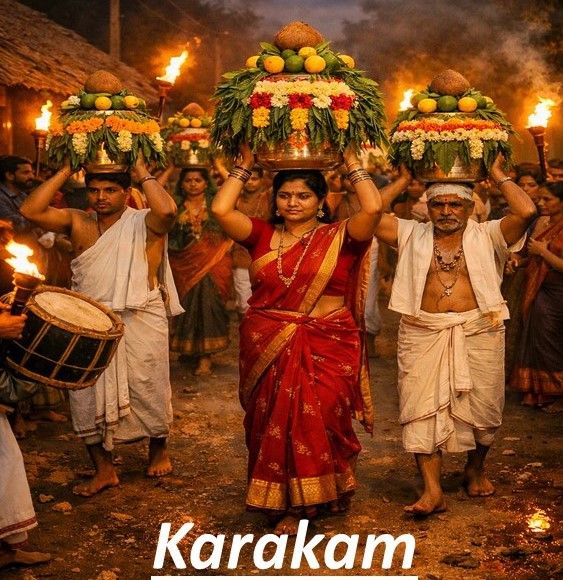
India’s villages are deeply rooted in traditions where spirituality seamlessly blends with everyday life. Among these practices, the ritual of Karakam holds a unique place, symbolizing divine protection, purification, and the invocation of benevolent forces. This ritual reflects the Indian worldview that unseen energies influence human life, and collective ceremonies can safeguard communities against misfortune.
Guardian Deity Sastha
At the heart of village spirituality lies Sastha, revered as the supreme protector. His temple is often the spiritual nucleus of the community. Villagers vow to take Sastha in procession through the streets, either to celebrate success or to seek blessings for prosperity. These processions are conducted only at night, as Sastha is regarded as the suzerain lord of supernatural beings, commanding respect even from minor deities.
Processions to Avert Calamity
When minor deities are displeased, they are believed to unleash epidemics or misfortunes upon the village, affecting people, cattle, or crops. To counter this, villagers carry Ayyan (a form of Sastha) through the streets at night. The ritual is marked by burning torches, beating drums, and sounding trumpets. At each household, offerings of incense, fruits, broken coconuts, and camphor are made. The deity is then returned to the temple late at night, believed to have pacified The Spirits and Restored Harmony.
The Karakam Ritual
Distinct from deity processions, Karakam involves carrying a decorated pot filled with water. The pot is adorned with margosa leaves, flowers, sandal paste, and lime fruit. Selected individuals, who must remain pure and clean, carry these pots on their heads through the streets during epidemics. The belief is that the Karakam absorbs negative energies and checks the spread of disease, serving as a spiritual safeguard for the community.
Symbolism in Religious Ceremonies
In auspicious Hindu rituals, a pot of water is placed on paddy spread over a clean, decorated ground. Mango leaves are placed atop the pot, crowned with a coconut. After chanting mantras, the water is believed to acquire sacred properties. It is consumed or sprinkled to purify individuals and objects, invoking benevolent spirits while repelling malevolent ones. Evening twilight is considered the most potent time for carrying Karakam, as spirits are believed to be most active then.
Protective Customs in Daily Life
The symbolism of water-filled vessels extends beyond Karakam. For instance, when houses are built, a white pumpkin (Sambal Poosanikdi) is hung at the entrance to ward off evil spirits. Just as Karakam purifies streets, the pumpkin prevents harmful entities from entering newly constructed homes. This reflects the broader belief that spirits prefer ruins and uninhabited places, and rituals ensure they are kept at bay.
Cultural Uniqueness
The practice of Karakam is distinctive to India, with no parallel in other cultures. It embodies the fusion of faith, symbolism, and communal effort to safeguard villages against unseen forces. Whether through deity processions or water-filled pots, these rituals reinforce the bond between The Divine and The Community, ensuring spiritual protection and collective well-being.
Conclusion
Karakam is more than a ritual it is a living tradition that reflects the Indian worldview where spirituality permeates daily life. By offering both protection and purification, it continues to strengthen the cultural fabric of villages, ensuring harmony between humans, nature, and the divine.