
Introduction
Bagalkot District is a prominent administrative region in the northern part of Karnataka, India. Nestled on the Northern Karnataka Plateau, which forms a segment of the vast Deccan Plateau, Bagalkot is geographically positioned at 16°12′N latitude and 75°45′E longitude. The district headquarters is located in the town of Bagalkot itself. Known for its rich historical legacy, architectural marvels, and vibrant culture, Bagalkot is a microcosm of Karnataka’s diverse heritage.
History of Bagalkot District
Early History
Bagalkot Historical Roots trace back to prehistoric times. Archaeological discoveries in the Kalagadi basin and Malaprabha valley have unearthed Middle Palaeolithic tools, megalithic burial sites, and pre-Chalukyan brick temples. These findings suggest that the region was inhabited by early human civilizations, making it one of the oldest settled areas in Karnataka.
Medieval History
Bagalkot rose to prominence during the Chalukya dynasty, which ruled much of South India from the 6th to the 12th century CE. Pulakeshin I established Bagalkot as an administrative center, and his successor Pulakeshin II famously defeated Emperor Harshavardhana on the banks of the Narmada River. The region flourished under the Chalukyas, with towns like Aihole, Badami, and Pattadakal becoming hubs of temple architecture and cultural development. Later, the Rashtrakutas, Kalyani Chalukyas, Hoysala, and Yadavas of Deogiri successively ruled the area, each leaving behind architectural and cultural imprints.
Modern History
In the 14th century, Bagalkot came under the influence of the Bahmani Sultanate and later the Adil Shahi dynasty of Bijapur. During British colonial rule, Bagalkot was part of the Bombay Presidency. Post-independence, it was integrated into the state of Mysore (now Karnataka). In 1997, Bagalkot was carved out of the larger Bijapur district to become a separate administrative entity.
Historical References
Bagalkot finds mention in ancient texts and foreign accounts. The Greek astronomer Ptolemy referenced towns in the region, and the Chinese traveler Hieun-Tsang described the people of Badami as “tall, proud, brave and exceedingly chivalrous”. Stone inscriptions and coins from various dynasties further attest to Bagalkot historical significance.
Geography of Bagalkot District
Bagalkot spans an area of approximately 6,593 square kilometers and sits at an elevation of 524 meters above sea level. The district is bordered by Belgaum, Gadag, Koppal, Raichur, and Bijapur. Three major rivers Krishna, Malaprabha, and Ghataprabha flow through the district, enriching its soil and supporting agriculture. The terrain is predominantly dry and rocky, characteristic of the Deccan Plateau.
Economy of Bagalkot District
Agriculture forms the backbone of Bagalkot economy. The fertile river basins support the cultivation of sugarcane, cotton, groundnuts, and pulses. The district is also known for its limestone and granite deposits, which fuel the construction and mining industries. Bagalkot has a growing industrial sector, with textile units in towns like Ilkal and Mudhol contributing to local employment. Handloom weaving, especially Ilkal sarees, is a traditional craft that sustains many families.
Demography of Bagalkot District
As per the 2011 Census, Bagalkot has a population of approximately 1.89 million, with a density of 290 people per square kilometer. The district comprises ten taluks, including Badami, Bagalkot, Bilagi, Guledgudda, Rabkavi Banhatti, Hunagund, Ilkal, Jamakhandi, Mudhol, and Teradal. Kannada is the official and most widely spoken language. The literacy rate stands at around 70%, and the district has a balanced gender ratio.
Culture of Bagalkot District
Bagalkot culture is a vibrant blend of ancient traditions and contemporary practices. The region is known for its classical music, folk dances, and festivals like Basava Jayanti and Ugadi. The influence of Lingayat philosophy, propagated by Basavanna, is deeply rooted in the social fabric. Traditional crafts such as Ilkal saree weaving and stone carving continue to thrive. The cuisine of Bagalkot reflects the flavours of North Karnataka, with dishes like jowar roti, yennegai, and chutneys being staples.
Tourism in Bagalkot District
Pilgrimage Tourism
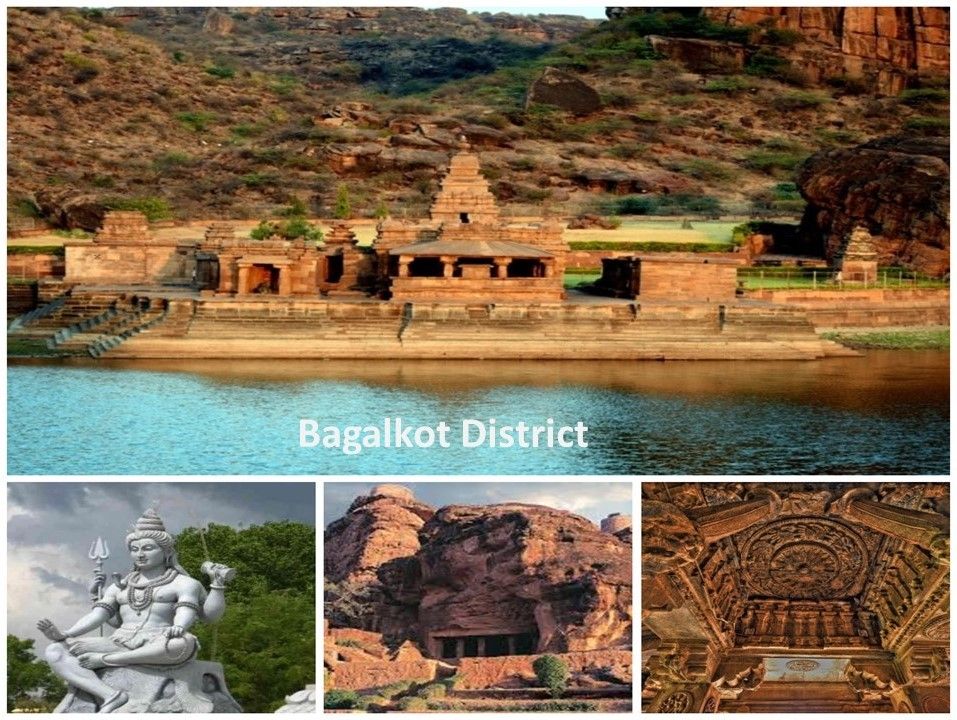
Bagalkot is a spiritual haven for pilgrims. Kudalasangama, located at the confluence of the Krishna and Malaprabha rivers, is the final resting place of Basavanna, the founder of the Lingayat sect. Aihole, often referred to as the “Cradle of Indian Temple Architecture,” houses over 100 temples from various periods. Pattadakal, a UNESCO World Heritage Site, showcases a harmonious blend of Dravidian and Nagara architectural styles. Badami, with its cave temples carved into sandstone cliffs, is another major pilgrimage and heritage site.
Leisure Tourism
Beyond its spiritual allure, Bagalkot offers scenic landscapes and historical exploration. The cave temples of Badami, the Durga temple at Aihole, and the Sangameshwara temple at Pattadakal are architectural marvels that attract tourists and scholars alike. The district’s rivers and plateaus provide opportunities for trekking, photography, and nature walks. Local markets and craft centers offer a glimpse into the region’s artisanal heritage.
Bagalkot District stands as a testament to Karnataka’s layered history and cultural richness. From ancient dynasties to modern development, from sacred temples to bustling markets, Bagalkot is a destination that invites exploration, reverence, and admiration. Whether you're a history buff, a spiritual seeker, or a curious traveler, Bagalkot promises an experience that’s both enlightening and unforgettable.