
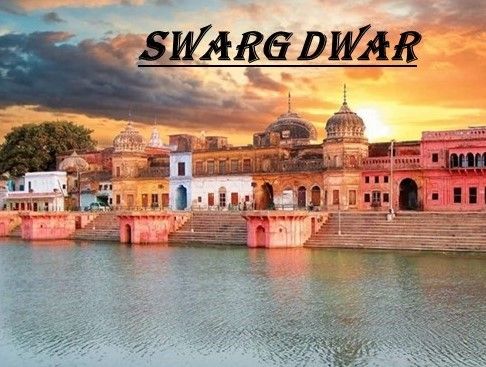
Swarg Dwar, also known as Ram Ghat, is one of the most revered and historically significant sites in Ayodhya. Located about half a kilometre north of the Ram Janmabhoomi, this ghat is believed to mark the place where Lord Rama, the seventh incarnation of Lord Vishnu, was cremated. The stretch of land from Sahasradhara to Nageshwarnath Temple is symbolically referred to as Swarg Dwar, meaning “Gateway to Heaven,” making it a focal point of devotion and pilgrimage.
Mythological Significance
Swarg Dwar occupies A Unique Position in Indian Mythology. While certain scriptures narrate that Lord Rama ascended to Vaikuntha with his human body after crowning his sons, local traditions firmly hold that his earthly remains were consigned to flames at this ghat. This divergence of belief has sparked debates among scholars and devotees, yet it only adds to the mystique of the site. Similar gateways to heaven exist in other pilgrimage centres such as Dwarka and Puri, but Ayodhya’s Swarg Dwar remains uniquely tied to Rama’s legacy and continues to draw pilgrims from across the country.
Architectural and Cultural Heritage
The ghat is adorned with temples and shrines that enrich its spiritual atmosphere. The Rama Temple and Badi Narayana Temple are prominent landmarks, while nearby teerthams such as Kala Ganga and Tamra Varaha add to its sanctity. The Sanga Veda School, a renowned centre of Vedic learning, is located nearby and hosts grand celebrations during the birthdays of Lord Rama and Lord Ganesha, keeping alive the traditions of ancient scholarship and devotion.
The architectural beauty of the ghat is equally captivating. The buildings along the Sarayu River were constructed in the 18th century by Nawab Naval Rai, a Hindu noble in the court of Safdar Jung. Though time has weathered these structures, they still present a majestic view from afar. Interestingly, the Sarayu River has shifted northwards over the years, moving away from the original ghats. To adapt to this change, new ghats were built in the 1960s near the modern bridge, offering visitors a scenic vantage point to admire the riverfront.
Controversies and Interpretations
Swarg Dwar is not without its controversies. The contradiction between scriptural accounts and local traditions raises questions that often defy logical or scientific explanation. While the Ramayana describes Rama’s divine departure to Vaikuntha, the existence of a cremation site in Ayodhya suggests a different narrative. Such paradoxes are common in Indian mythology, where faith and folklore intertwine seamlessly. Devotees, however, continue to revere the site, considering it a sacred link to their beloved deity, regardless of scholarly debates.
Ayodhya: The Eternal Pilgrimage Centre
Ayodhya itself is a city of immense historical and religious importance. Founded by Manu, the first king of mankind and lawgiver, it served as the capital of the Surya dynasty for centuries. During the Treta Yuga, Rama emerged as its most illustrious ruler. Known also as Kaushal kingdom, Ayodhya is celebrated as the birthplace of Rama, hence the title Ram Janmabhoomi.
Modern Ayodhya, located on The Banks of the Sarayu River, is dotted with over a hundred temples. Among the most notable are Kanak Bhavan, dedicated to Rama and Sita; Hanuman Garhi, a hilltop shrine with a flower-adorned statue of Hanuman; and Kshireshwaranath Temple, established by Rama’s mother, Kausalya. The city also features numerous kunds and ghats linked to mythological figures, such as Brahma Kund, Sita Kund, Bharat Kund, and Lakshman Ghat, each adding to the spiritual richness of Ayodhya.
Conclusion
Swarg Dwar is more than just a ghat; it is a symbol of Ayodhya’s layered history, where mythology, devotion, and heritage converge. Whether regarded as the cremation site of Lord Rama or as a spiritual gateway to the divine, it continues to inspire reverence among millions of pilgrims. Alongside Ram Janmabhoomi and other sacred landmarks, Swarg Dwar reinforces Ayodhya’s identity as a timeless centre of faith and culture.