
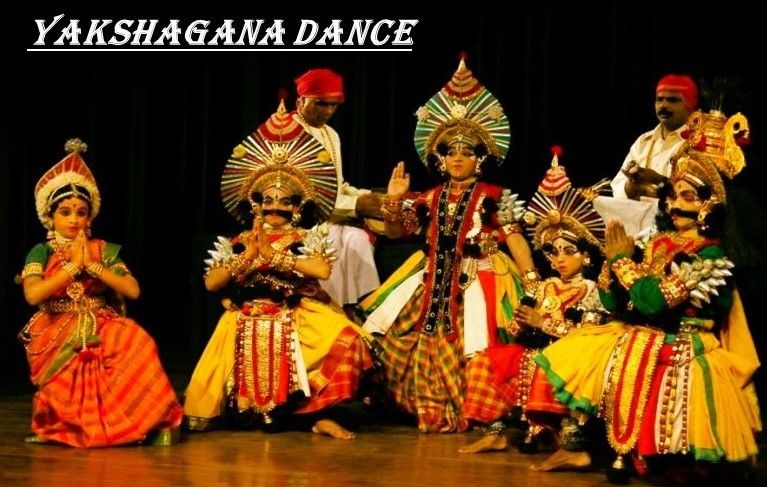
Yakshagana, the traditional folk theatre of Karnataka, is a unique blend of dance, drama, music, and storytelling. Its performance is not confined to enclosed spaces but traditionally unfolds in the open air, often in front of village temples. The Grandeur of Yakshagana lies not only in its costumes and music but also in the immersive way it engages audiences throughout the night.
Setting the Stage
On the evening of a performance, the Chandedrum is beaten to announce the event and invite neighboring villages. Its sharp, penetrating sound can travel several miles, drawing people from far and wide. The stage, usually a 16-foot square platform, is constructed with bamboo poles at the corners, covered with palm-leaf mats, and decorated with flowers, mango leaves, and plantain trees. The audience sits on three sides, while the Bhagavata (lead singer and narrator) and his musicians take their place at the rear with instruments like Maddale, Mridanga, Chande, and Pungi.
Elements of Yakshagana
The performance begins with Nandi, prayers sung to Lord Ganapati and Subrahmanya. The jester Kodangi then enters in a humorous costume, dancing and singing to entertain the crowd. Following him, minor roles called Tundu Vesha and Nitya Vesha appear, engaging the audience with songs, dances, and comic exchanges.
The Bhagavata signals the entrance of the main characters, who emerge one by one from behind a curtain until the most important role, Bannada Vesha, appears. This marks the Poorvaranga, or preliminary formalities. The Bhagavata then sings the Prastavane, the prologue to the chosen play, and as the tempo rises, the characters begin their dramatic enactment. Each role dances onto the stage, with movements tailored to the emotions and spirit of the character.
Music and Dramatic Flow
Music is central to Yakshagana. After a brief dance, the Bhagavata introduces each character, traditionally through interrogation, though in modern times characters often introduce themselves directly. The Bhagavata’s verses guide the performance, with actors interpreting them through dance, gesture, and prose.
The climax of Yakshagana is often a battle scene. Accompanied by the vigorous beats of Chande and Mridanga, characters engage in war dances full of rustic energy and grandeur. The audience, enthralled by the spectacle, often loses track of time as the performance continues through the night. Traditionally, plays concluded at sunrise with prayers to the Sun God, though this custom has faded.
Colors and Make-up
Yakshagana’s visual appeal lies in its striking use of colors. Each character’s face is painted to reflect their nature: gods in reddish white, Yama and Bali in black, Krishna in blue, and Bannada Vesha in black or pink. Indigenous pigments like Aradala, Ingaleeka, Kadige, and Balapa were historically used. Mythological figures such as Narasimha, Ravana, and Yama are given exaggerated features cotton lumps to raise the nose, enlarged eyes, decorative white dots (Chutti), and artificial teeth to create an illusion of masks.
The Actors
Yakshagana actors are multi-talented, serving as dancers, make-up artists, and improvisational performers. They must be physically strong to endure heavy costumes and vigorous dances, while also possessing presence of mind and spontaneity. Unlike modern theatre, Yakshagana has no written dialogues; the Bhagavata provides verses, and actors improvise their responses. This freedom ensures that each performance is fresh and unique.
Renowned performers such as Kumbale Naranappa, Kokkarane Ganapati, and Upparahalli Shesha are remembered for their mastery, while contemporary artists like Keremane Shivarama Hegde and K. Vittala Sastri continue to uphold the tradition.
Conclusion
The Performance of Yakshagana is more than entertainment it is a cultural celebration that blends devotion, artistry, and community. With its open-air setting, powerful music, vibrant colors, and improvisational spirit, Yakshagana remains a living tradition that reflects the rich heritage of Karnataka.