
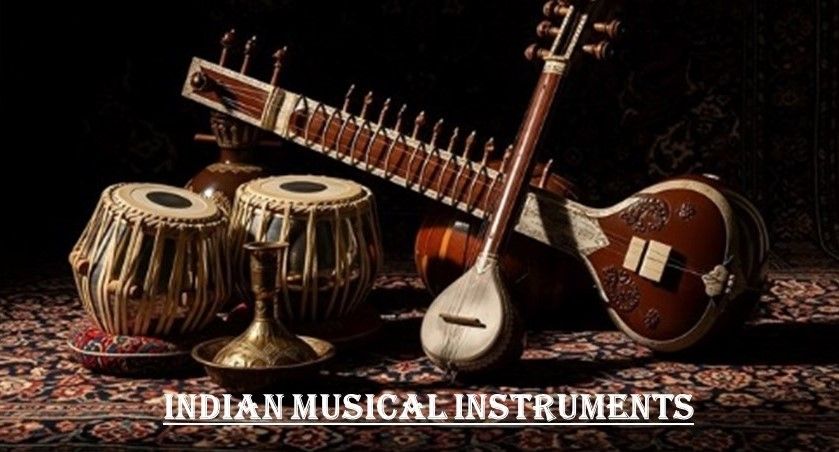
The sketch of Indian culture remains incomplete without music. Since ancient times, music has evolved with new forms and styles, and instruments have played a vital role in enhancing its essence. During the medieval period, Indian music witnessed remarkable growth, enriched by influences from Persia, Central Asia, and local traditions. The Musical Instruments of medieval India became popular across courts, temples, and folk gatherings, adding new dimensions to the cultural heritage of the country.
Rubab
The Rubab, resembling a lute, was introduced to India through Persian influence. Crafted from a single piece of wood with animal skin forming its head and strings, it produced a soulful tone. A spike at one end provided balance, and it could be played either with a bow or by plucking. With three main melody strings, the Rubab was versatile but limited in range. Over time, it was gradually replaced by the violin, which offered greater flexibility.
Sarod
Closely related to the Rubab, the Sarodbecame one of the most prominent instruments of northern India. Known for its deep, intense sound, it allowed continuous slides between notes, creating a unique melodic flow. A bone plectrum was used to pluck its strings, producing rich and resonant tones. The Sarod’s popularity grew in the medieval era and it remains a cornerstone of Hindustani classical music today.
Tambura
The Tambura is a plucked lute with a long neck and four to five strings. It produces a continuous drone that supports the main melody, creating a harmonic base for performances. Traditionally made from hollowed wood or gourds, with jackwood being the most common material, the Tambura was indispensable in medieval music ensembles.
Sitar
The Sitar, one of the most iconic instruments of India, originated in the medieval period. It features a gourd resonator and a long hollow neck made of wood. Sympathetic strings beneath the main strings create resonance, giving the Sitar its distinctive sound. Precise tuning is essential, and its melodies became central to courtly and classical performances.
Dilruba
The Dilruba was prevalent in north-west India during the medieval era. With a long neck and 18 strings, it was tuned similarly to the Sitar but played with a bow. Only one main string was used for melody, while sympathetic strings added depth. Its haunting sound made it popular in devotional and classical contexts.
Pakhavaj
The Pakhavaj is a barrel-shaped, two-headed drum descended from the ancient Mridangam. It was widely used to accompany dance and vocal performances. Rhythms were played using mnemonic syllables, making it a vital percussion instrument in medieval music traditions.
Dholak
The Dholak is a folk percussion instrument of medieval India. With two heads and variable pitch depending on size, it was commonly used in kirtans, bhangra, and qawwali. Its lively rhythms made it a favorite in community gatherings and festive occasions.
Other Instruments
Besides these, medieval India also saw the use of the Veena, Sarangi, Mayuri, Tabla, Nakkara, Bansuri, and Been, each contributing to the diversity of Indian music.
Conclusion
The musical instruments of medieval India reflect a period of Cultural Fusion and Innovation. They enriched traditions, added vigor to performances, and became integral to both classical and folk music. Though many have evolved over time, their legacy continues to shape the soundscape of Indian music, standing as timeless testaments to India’s artistic brilliance.