
Introduction
The Vijayanagar Empire remains one of the most illustrious chapters in South Indian history. For over three centuries, it flourished under four successive dynasties the Sangama, Saluva, Tuluva, and finally the Aravidu. Each dynasty contributed to the empire’s political consolidation, cultural vibrancy, and architectural magnificence. Yet, it was the Aravidu Dynasty, the last Hindu ruling family of Vijayanagar, that presided over its decline between the mid‑16th and mid‑17th centuries. Their reign was marked by resilience and determination, but despite their efforts, they could not restore the grandeur once achieved under celebrated rulers like Krishnadeva Raya.
Rise of the Aravidu Dynasty
The Aravidus rose to prominence in the aftermath of the catastrophic Battle of Talikota in 1565 CE. This battle, fought between Vijayanagar and a coalition of the Deccan Sultanates Bijapur, Ahmadnagar, Golconda, and Bidar resulted in the sacking of the capital city and the destruction of its military might. The empire never fully recovered from this devastating blow. Amidst the chaos, Tirumala Deva Raya, brother‑in‑law of Rama Raya, assumed leadership and established the Aravidu line.
From the very beginning, The Aravidus faced relentless challenges. They had to contend with repeated invasions from the Sultanates, rebellions from provincial Nayaks, and the growing independence of southern powers such as Madurai, Tanjore, and Gingee. Their reign became a prolonged struggle to preserve fragments of the empire’s former strength rather than expand its boundaries.
Key Rulers of the Aravidu Dynasty
Several rulers defined the trajectory of the Aravidu Dynasty:
- Rama Raya (1542–1565 CE) – Though technically of the Tuluva line, Rama Raya’s regency under Sadasiva Raya set the stage for the Aravidus. His policy of manipulating the Deccan Sultanates against one another backfired, culminating in the Talikota disaster. His death marked the end of Vijayanagar’s dominance.
- Tirumala Deva Raya (1565–1572 CE) – Founder of the Aravidu Dynasty, he shifted the capital from the ruined Vijayanagar to Penukonda, and later to Chandragiri, in an attempt to stabilize the empire.
- Sriranga Deva Raya I (1572–1586 CE) – He defended the empire against repeated invasions and managed to retain some control over southern provinces.
- Sriranga II (1614 CE) – His brief and unstable reign reflected the weakening grip of central authority.
- Rama Deva Raya (1617–1632 CE) – He attempted to consolidate power but faced rebellion from provincial chiefs, further fragmenting the empire.
- Venkata III (1632–1642 CE) – His reign was plagued by invasions from the Golconda Sultanate and internal strife.
- Sriranga III (1642–1652 CE) – The last ruler of the dynasty, he rebelled against his predecessors and allied with Sultanates. His insurrections, combined with external invasions, sealed the fate of the empire.
Political Struggles and Rivalries
The Aravidus were constantly embroiled in negotiations, battles, and shifting alliances with the Deccan Sultanates. These unstable relationships weakened Vijayanagar’s position further. Rival claimants like Timma Raja briefly seized power, adding to the instability. Meanwhile, the Nayaks of Madurai, Tanjore, and Gingee asserted independence, eroding central authority.
One significant development during this period was the Madras land grant. The British East India Company received land near modern‑day Chennai, marking the beginning of European footholds in South India. This seemingly minor event foreshadowed the colonial era that would dominate the subcontinent in the centuries to come.
The Battle of Talikota: A Turning Point
The Battle of Talikota was the defining moment in Vijayanagar’s decline. Rama Raya’s forces were crushed by the coalition of Sultanates, and the capital city was sacked and burned. The destruction of Vijayanagar symbolized the end of its golden age. The Aravidus inherited an empire already in ruins, and their reign was essentially an attempt to preserve what remained of its grandeur.
Architecture and Cultural Contributions
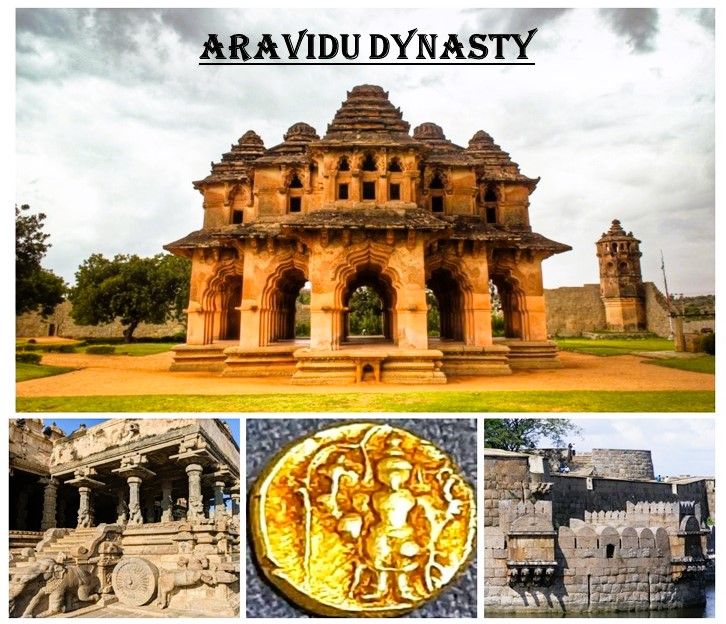
Despite political decline, the Aravidus continued their patronage of art and architecture. The Chandragiri Fort and structures in Penukonda reflect their contributions. Though not as monumental as earlier Vijayanagar works like the temples of Hampi, these structures demonstrate their commitment to preserving cultural traditions.
In literature, Telugu and Sanskrit works continued under their patronage. Court poets composed devotional and epic poetry, though on a smaller scale compared to the flourishing seen under the Tuluva dynasty. Their efforts ensured that the empire’s cultural identity remained intact even as political power waned.
Administration and Economy
The Aravidus retained the administrative framework of Vijayanagar:
- A central authority supported by provincial governors.
- Revenue collection based on land surveys.
- Military organization dependent on provincial Nayaks providing troops.
However, weakening control over the Nayaks eroded this system. Economically, agriculture and temple revenues remained vital, while ports on the Coromandel Coast facilitated trade with Europeans. Yet, constant warfare and territorial losses reduced prosperity, leaving the empire financially strained.
Culture and Legacy
Even in decline, the Aravidus upheld Hindu traditions, festivals, and temple rituals. They preserved aspects of Vijayanagar Cultural Legacy, including art, music, and dance forms such as Bharatanatyam. Their reign represents resilience amid adversity, ensuring that the empire’s cultural identity survived even as political power diminished.
The Aravidus also played a transitional role in South Indian history. Their decline coincided with the rise of Sultanates and the growing influence of European powers, marking a shift toward a new era.
Conclusion
The Aravidu Dynasty symbolizes the twilight of the Vijayanagar Empire. From Rama Raya’s overreach to Sriranga III’s final struggles, their history is one of resilience against overwhelming odds. Though unable to restore the empire’s former glory, they preserved fragments of its grandeur and cultural heritage. Their reign also marked the transition of South India into a new era dominated by Sultanates and European colonial powers.